

My least favorite bird fact is “blue birds aren’t really blue.” Well, no – that’s not true. My least favorite bird fact is that North America’s bird population has declined by more than 3 billion over the last 55 years. My least favorite bird fact to be told is “blue birds aren’t really blue.”
The people who tell me this are kindred spirits: They’re bird lovers, conservationists, adherents of science, and they like to say interesting things. And it IS interesting:
“Red and yellow feathers get their color from actual pigments, called carotenoids, that are in the foods birds eat,” [wildlife biologist Scott] Sillett explains. “Blue is different―no bird species can make blue from pigments. The color blue that we see on a bird is created by the way light waves interact with the feathers and their arrangement of protein molecules, called keratin. In other words, blue is a structural color. […] A blue feather under ultraviolet light might look uniformly gray to human eyes.” [Smithsonian]

A cardinal, a vermilion flycatcher, a goldfinch, a yellow warbler: they have chemical color. Indigo buntings and blue grosbeaks have structural color (which blog headline writers interpret as not actual color). A more straightforward example:
If a cardinal’s red feather were ground into powder, the powder would be red… [The] feathers of a bluebird would reduce to a drab brown powder. [Birdwatching Daily]
Sure. Cool. I welcome the knowledge, but I don’t find it applicable to the joy of birding or the experience of living. I never saw an Eastern Bluebird on a frigid March morning in Connecticut and thought “If I plucked that bird and ground those feathers up it would be a drab brown powder.” My heart was too buoyant with the prospect of spring, light, warmth, bloom. When I first saw a Little Blue Heron in Texas wetlands, I did not wonder if it would look gray under ultraviolet light. I remember the morning’s rising heat and snapping what photos I could with a dying camera battery. Imagine: silly me, on a perfect autumn day in Central Park, surrounded in the Ramble by Black-Throated Blue Warblers just out of arm’s reach, experiencing a slack-jawed, wet-eyed wonder and gratitude for our Earth, not once pausing to think about how their feathers would look shitty if I could reduce them to powder.

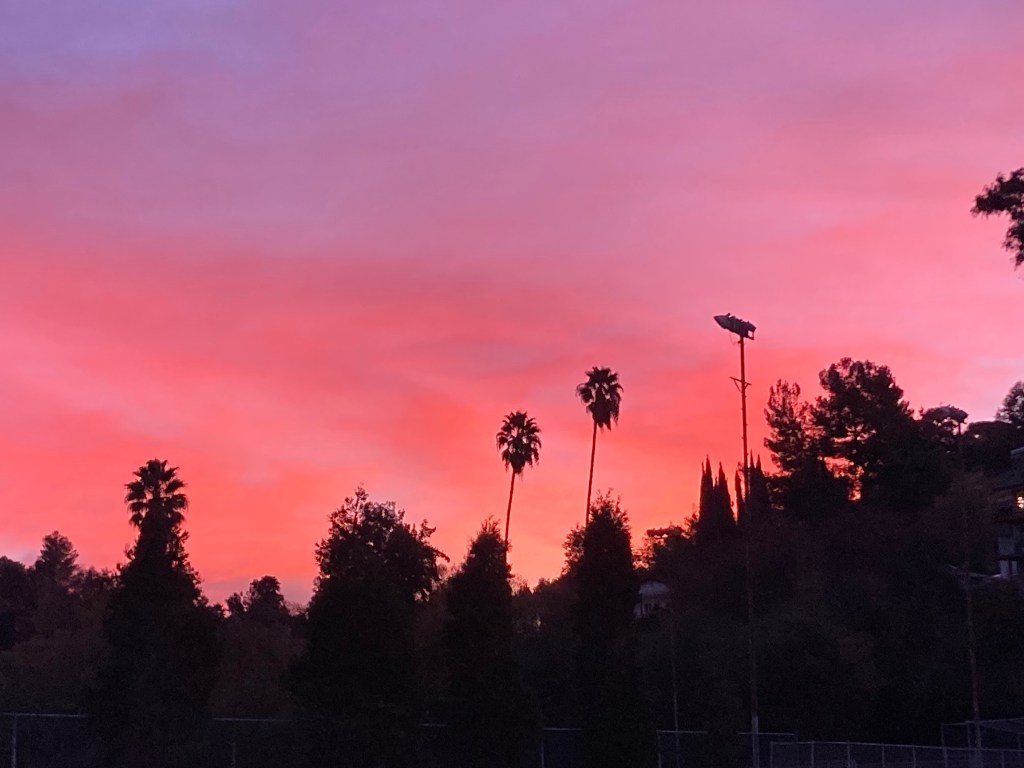
This is by no means a rejection of scientific explanations for the world’s magic. Without looking it up or sounding too dumb, I can probably give a B-minus explanation of why a sunset changes the color in the sky (light from the sun has a longer trip through the atmosphere, scattering light at different wavelengths …. right?), and that doesn’t stop me from being a big basic dork who stops and watches a sunset ten times out of ten. As John Green once said, “I think it’s helpful to know how sunsets work and I’ve never bought the romantic notion that scientific understanding somehow robs the universe of its beauty, but it still doesn’t communicate much about how breathtakingly beautiful sunsets are.” Science isn’t sufficiently equipped for feelings. I won’t quibble with it, but I reject an interpretation of the world that demeans its splendor, that undercuts my wonder.
Another such interpretation: Purple isn’t real, per Popular Mechanics. I would love to blockquote the text (the true mark of an aughts blogger), but it doesn’t have a central explanatory paragraph, so it’s on me to synthesize. Here goes:
- Purple does not exist on the wavelengths of color visible to the human eye.
- Violet does exist, but doesn’t count as purple. (???)
- When our eyes “see” a combination of blue and red wavelengths – the waves at the outer ranges of our visible spectrum – our brains combine them and interpret it as purple.
Great. Cool. Fun party fact for stoned college sophomores. Just two problems with this: One, by saying “purple isn’t real because it’s a non-spectral color” you are by default also declaring magenta, pink, and cyan not-real colors (They are derived from monochromatic colors but do not have their own wavelengths in the visible spectrum, is how I understand it. Hard to know for sure, as this is all extremely dull to me). Many things that are straightforward in science – monochromatic color is scientifically different than non-spectral color – become transmuted to “purple isn’t real” by desperate souls trying to survive the last writing jobs in an industry hollowed out by the internet, social media, and AI. Two: Violet is purple. Get out of my face.
Why quibble with this? Why does it burn my bacon? Because I hate the evaporation of a shared objective reality. Whether it’s something as obvious and scientifically proven as climate change or the words said by people in government (often on video, broadcast nationally), there is a powerful media structure that states “NUH UH,” and half the country accepts that void as the truth.
Science is supposed to be on the side of facts, a sturdy anchor in the turgid rising water of lies and pseudoscience. When generally trustworthy websites (which is to say, those aligned with science) publish headlines like “Blue birds aren’t blue” and “Purple isn’t real,” how does the average reader disentangle that from politicians saying “climate change isn’t real” or the joke-turned-conspiracy “birds aren’t real”? What is real, if even science disputes it?
I’m here to tell you, human to human, that what you see in the real world – not on a screen but outside, with your own eyes, with the breeze on your arms and the great expanse of stars beyond – appears to you as God intended, as nature created, as evolution deemed necessary. The darkening sky is purple and the screaming jays are blue, and everywhere around you is the actual world: rich in delight, fraught with peril, worthy of your love.
 Feather Report
2 responses to “What You See Is Real”
If the bluebird isn’t blue, what color is it?
LikeLike
Always great to read some words by Matt Ufford. And some bird pics too!
LikeLike